Databasin vs Snowflake
Databasin is a data and AI platform with a team that designs, builds and supports business improvements. Choose it when you want the application and adoption work delivered together. Choose Snowflake when your team or partner will develop on its data and AI capabilities. You can also keep Snowflake and engage Databasin for the work around it.
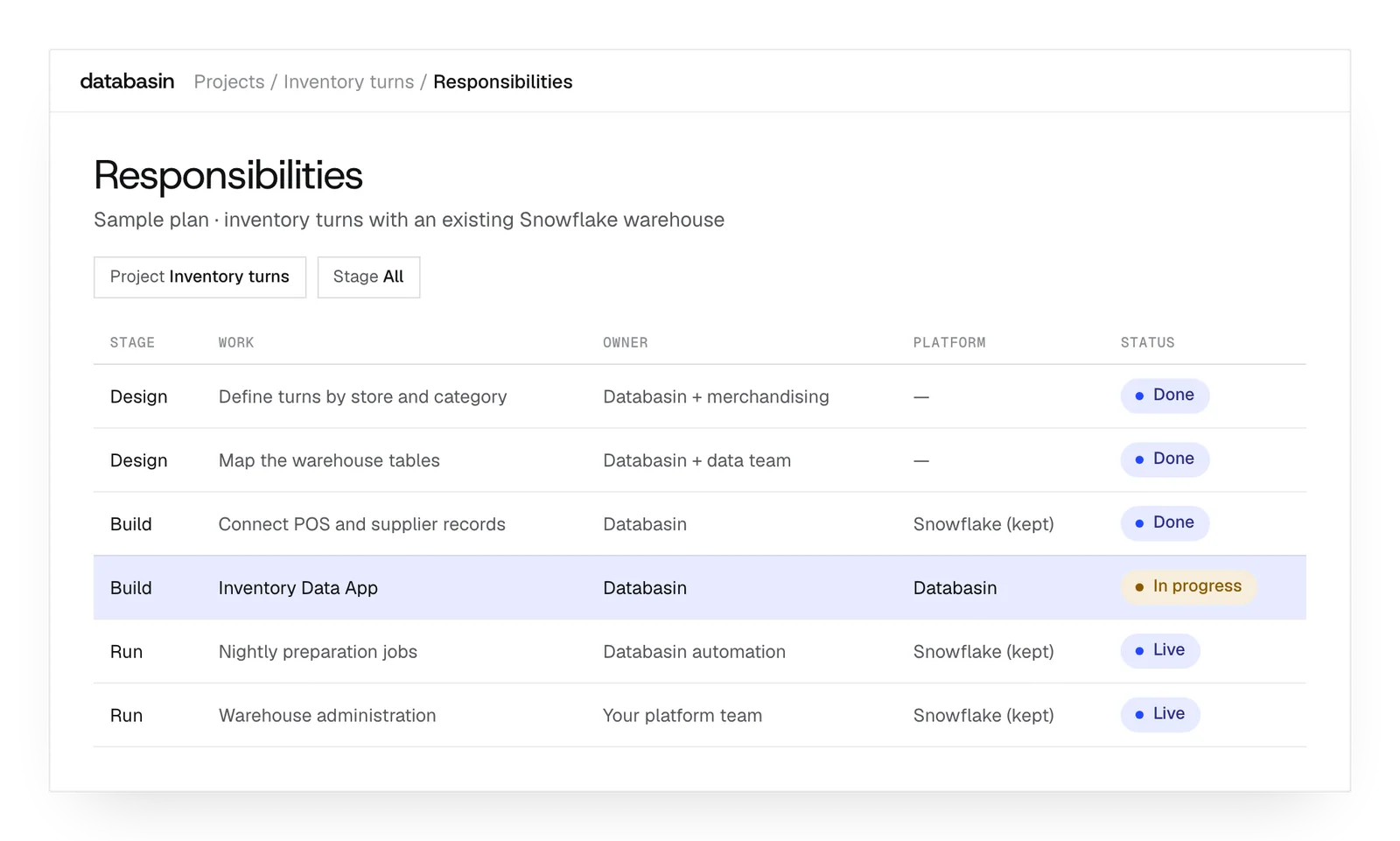
 databasinvs

Choose by delivery needs
Choose Databasin if…
- You want Databasin's builders to deliver the application and help people use it.
- Source preparation and shared definitions are delaying useful business answers.
- The work needs rollout, training and an ongoing support arrangement.
Choose Snowflake if…
- Your team wants to direct development on Snowflake's data platform.
- Existing models and applications support the work you intend to extend.
- Your internal team or partner covers implementation and business adoption.
What does each approach provide?
| Criterion | Databasin | Snowflake |
|---|---|---|
| Main offer | Business improvement delivered with its platform | Managed data platform and AI capabilities |
| Source preparation | Team implements connections and business views | Native and ecosystem tools for your builders |
| Business reporting | Data Apps or useful existing BI | Applications and connected reporting tools |
| AI analysis | Databasin One with SQL evidence | Cortex tools for governed AI applications |
| User adoption | Communication, rollout and training included | Organized through your delivery arrangement |
| Existing warehouse | Snowflake can remain in the architecture | Extend the environment already in use |
Preparation
Who prepares data for the business?
Databasin
We handle the source work behind the business question, including the relationships and history in systems such as Epic and Workday. Our team connects those records and implements the required measures. The application can then use shared views with definitions that fit the work.
- Connect relevant operational source records
- Implement relationships and historical definitions
- Prepare shared views for business use
Snowflake
Snowflake manages storage and processing infrastructure. Internal builders or a partner develop the source connections and models on that platform. They choose the architecture around the organization's analytical questions and the applications that will use the data.
- Use managed storage and processing
- Develop source and transformation routes
- Build models for the intended applications
Business use
How do users get answers?
Databasin
We build the reporting around the decisions people need to make. They can use Data Apps and plain-English analysis, with SQL available behind Databasin One answers. Useful BI interfaces can stay while our team prepares the definitions and data behind them.
- Build Data Apps for recurring analysis
- Inspect the SQL behind answers
- Keep useful existing BI interfaces
Snowflake
Builders can connect BI tools or create AI applications using Snowflake. Cortex Agents works with structured and unstructured information through configured tools. Snowflake privileges govern access, while the builders shape the experience around the questions users need to answer.
- Connect reports to prepared warehouse data
- Use Cortex for analytical applications
- Configure tools and their data access
Delivery
Who delivers the ongoing improvement?
Databasin
We take the improvement through Design, Build, Run. That includes defining the outcome, implementing it and introducing it to users. After launch, the same team can operate the work, provide monthly support or stay on call under the agreed arrangement.
- Define the outcome and expected return
- Include rollout, training and success measurement
- Agree the continuing operating arrangement
Snowflake
Snowflake operates the platform infrastructure. An application team or partner develops business logic and helps people use the resulting applications. The organization directs that continuing work through its chosen builders and service arrangements.
- Use managed platform infrastructure services
- Retain ownership of application development
- Coordinate business adoption through the delivery team
Keeping a useful Snowflake environment
Databasin
Add implementation around the warehouse you already use
A Snowflake warehouse can be ready while the business application still needs source or model work. Databasin can complete that work and introduce the result to users. We design around useful infrastructure and reporting already in place, with delivery responsibilities agreed in the engagement.
- The platform exists but business use remains unfinished
- Difficult sources or definitions hold back the application
- Delivery needs support beyond the current team
Snowflake
Extend the current environment with your chosen builders
Snowflake fits when the current datasets and applications provide a good basis for the next use case. Internal builders or a partner can extend them using its native capabilities. This also preserves the architecture and operating practices the organization already knows.
- Existing models cover the planned business questions
- Current applications depend on Snowflake capabilities
- Your builders can deliver and support the extension
Databasin · How we work · 2026
Snowflake · Key concepts and architecture · 2026
Snowflake · Cortex Agents · 2026
What happens next
We would like to hear where your team wants to make progress with data and AI. We can discuss a project you have in mind or explore where Databasin could help with the work.
What happens next
Book a demo
Book a conversation about your organization and the work you want to improve. Questions about where to start are welcome.
Explore the opportunity
We show a working example that answers your business questions, then discuss what it would take to deliver it for your team.
Get the first result
After agreeing the first use case, we implement it with your team. We train the people using it and measure how it performs.
FAQ
Should unfinished reporting prompt a search for Snowflake alternatives?
Missing records, inconsistent measures and incomplete applications can hold up reporting on a suitable platform. We examine those dependencies during design. Databasin can address them alongside Snowflake, retaining the infrastructure that contributes to the intended result.
Does Snowflake already provide conversational AI?
Yes. Cortex supports questions over structured data and investigations using unstructured information. The useful comparison includes how each implementation prepares the models, applies permissions and presents answers. Databasin's team delivers that business use case and helps people start using it.
How are historical measures handled in a new application?
We establish which historical values the measure needs and which records are available. For Workday, this includes effective-dated relationships and the organization that applied in the reporting period. The model carries that date context through the calculation so comparisons use the intended history.
Does using Iceberg make every part of an application portable?
An open table format describes the stored records. Moving a working application also involves its models, workflows, access rules and report behavior. We examine those dependencies together to establish what a migration requires and which components remain useful where they are.
Can an existing dashboard stay while its source data improves?
Yes. We can improve the data behind an existing BI report. Our team establishes the definitions, refresh behavior and access the report expects, then builds the source and model changes around those requirements. The reporting interface can remain familiar to its users.
Are Snowflake permissions automatically copied into another application?
We trace the identity running each query and the rules that govern its records. The access design then covers the connected application and its intended users. That accounts for the actual connection path and the permissions it requires.
How does deployment differ between the platforms?
Snowflake provides its platform on public-cloud infrastructure. Databasin offers hosted deployment and Private Azure, and can work alongside an existing platform. The architecture discussion determines where the application runs and how its source and model connections operate.
What is included in Databasin's first use case?
The first use case includes the technical work and adoption needed for the agreed business outcome. Databasin's offer is to get it live in 90 days. Design defines the scope; build includes communication, rollout, training and success measurement.
Discuss the result you need
Talk with us about the business result you want and the Snowflake work already in place. We can explore where Databasin would contribute, including the implementation, rollout and support needed to make the application useful.