The data platform that arrives assembled

Warehouses store. Databasin answers.

Most teams get here by hiring three engineers and wiring six tools together. Databasin ships with the connectors, the pipelines, an open Iceberg lakehouse you own, and a model of every source already built. You point it at your systems. Then ask in plain English, and every answer comes back with the query it ran.

$50 credit · No card · Sign in with Google or Microsoft

Just your email. We build your workspace and send your sign-in link.

The receipt returned with every answer
SELECT department,
       avg(overall_rating) AS avg_overall,
       avg(likelihood_to_recommend) AS avg_ltr
FROM gold.patient_satisfaction
GROUP BY department
ORDER BY avg_overall DESC
tables
gold.patient_satisfaction
elapsed
2.1s
scanned
118 MB
query
20260803_141207_00042_xk9pq

Live in production at WashU Medicine.

Co-created at Washington University School of Medicine, on live regulated data from day one. Auditability, least-privilege access and keeping records inside your own tenant were requirements here before they were features anywhere else, and the platform has been built to that bar ever since.

We led with health systems and universities because they have the hardest governance constraints in the market. Databasin is not a vertical product. The same install runs Salesforce, NetSuite, Sage Intacct, Shopify, ServiceNow, Workday and 70 more. See the connector catalog →

  • WashU Medicine
  • Saint Louis University
  • KU Medical Center
  • KU Health System
  • St. Francis Medical Center
  • KVC Health
  • Technology Partners
  • McCormack Baron
  • Mers Goodwill
  • Compana Pet Brands
  • EKKL Streaming Services

The alternative

The alternative is a hiring plan.

To get what's on this page any other way, you buy ingestion, a warehouse, a transformation tool, an orchestrator, a pool of BI seats and an AI layer. Then you hire the two to five engineers who make those six things behave as one system, and keep them that way through every vendor API change.

$170 – 430K a year in licenses before headcount, across six renewal dates. That's our own audit of the stack →

Databasin is that stack, assembled, on one contract.

Why the answers hold up

Your data arrives already modeled.

Most AI tools point a language model at a dump of your raw tables and hope it guesses right. Ours doesn't have to guess. Here is what actually happens.

  1. 1

    You connect a source

    Pick Salesforce, NetSuite, Sage Intacct, your SQL Server, or any of the 75+ others. Sign in, choose what you want, set a schedule. A few minutes, no engineer.

  2. 2

    Databasin already knows its shape

    Our team has mapped each of these systems ahead of time: which tables matter, what the fields actually mean in business terms, and how they connect to each other. That map ships inside the connector, so nothing is left for you to define.

  3. 3

    You ask a question

    Your question runs against clean, business-ready tables instead of raw exports. That is why the answer comes back with a query you can read, and why it matches the number on your dashboard.

What about your custom fields?

The prebuilt map covers each vendor's standard setup. Anything custom you have added still lands in Databasin on the first sync, and the AI can help you fold it into your models. We build the part every company needs. Your own additions stay yours.

When a vendor changes their API

We change the connector, on our side, before it reaches you. Your pipelines keep running and your reports keep showing the same numbers. Nobody on your team gets a 2am page about a schema that moved.

Three ways in

Three ways to get an answer.

01 · Ask

Ask in plain English.

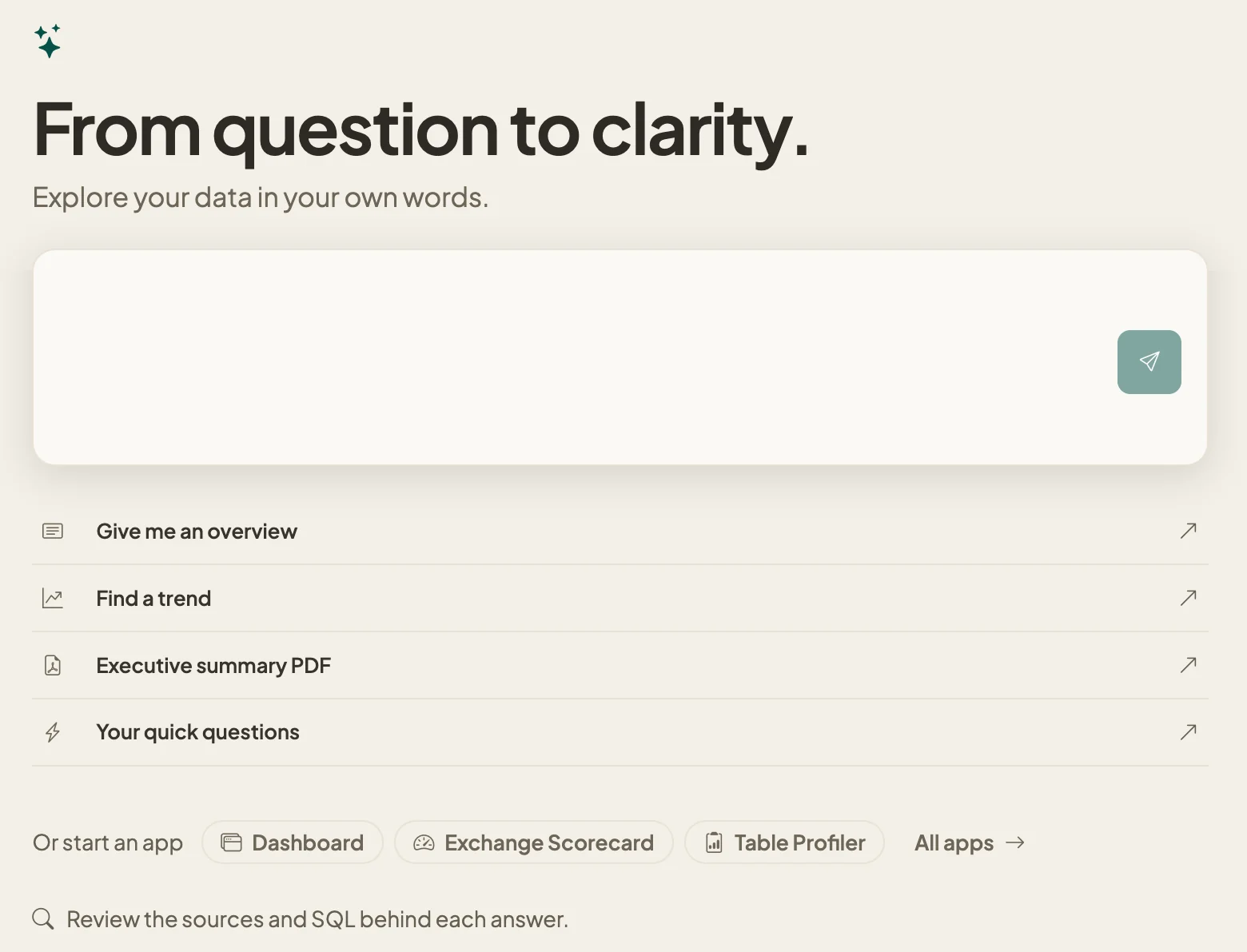
Databasin One, the AI analyst, works across everything you've connected. You ask a question; it picks the tables, writes the SQL, renders the chart, and hands back the receipt: the exact query it ran, the tables it read, how long it took, and how much it scanned. Trust it, or check it.

Queries the modeled views, never your raw tables · Trino and Spark over open Apache Iceberg in your storage · Holds a SELECT-only role: it cannot write, drop or alter

How the answer gets built

The analyst has a registered tool set, not a single text-to-SQL call: it can build dashboards, write documents and spreadsheets, propose semantic models and diagnose a broken connector, all in the same conversation. Bring your own key to Anthropic, OpenAI or Azure OpenAI; on Azure OpenAI in your own tenant, prompts and results never leave your subscription.

One honest limit: document search runs on keyword matching, not vectors. We say “search across your documents,” never “semantic search.”

02 · Watch Beta

Stop checking.
Get told.

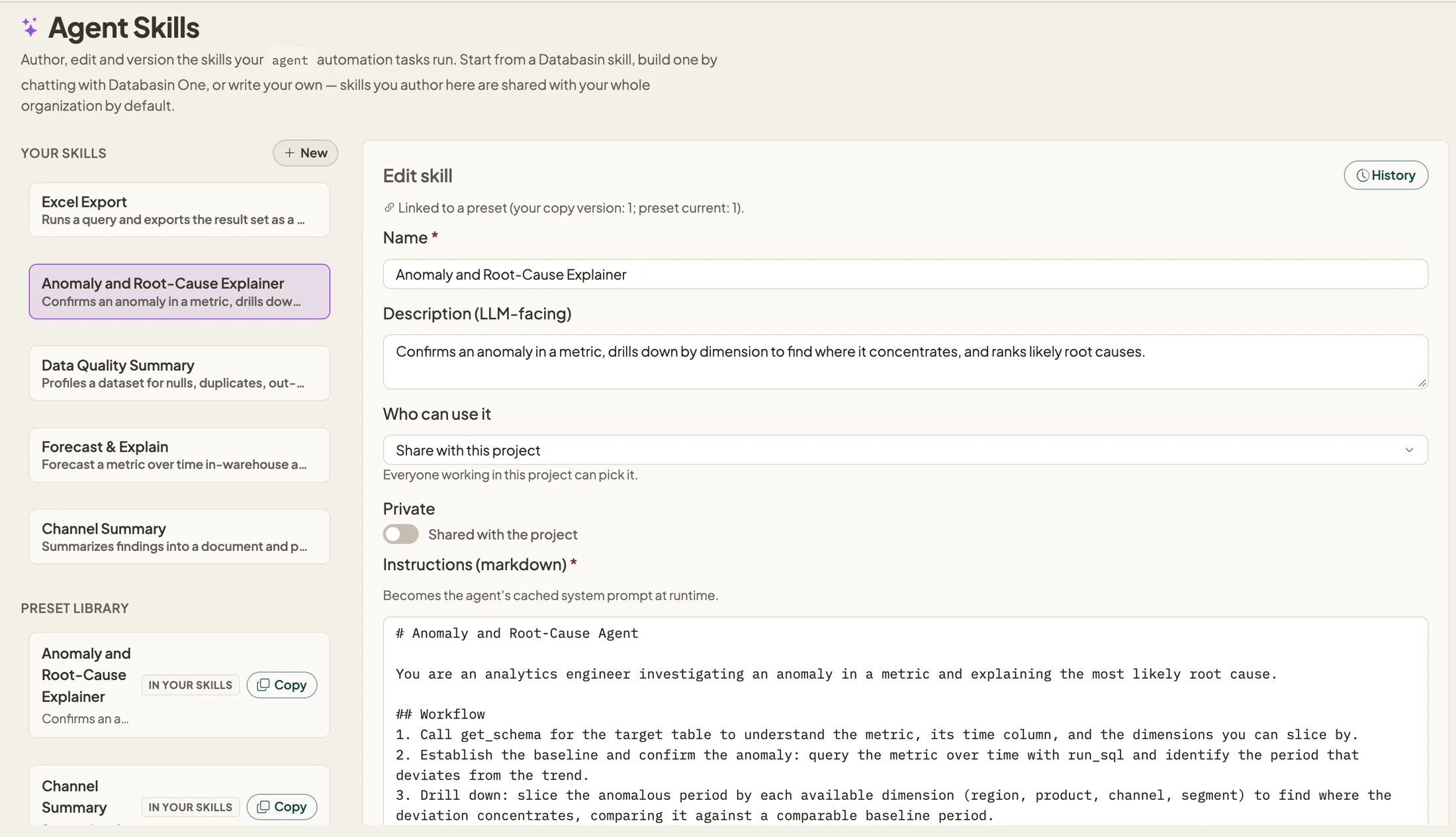
Describe the job once, in plain English: what to look at, and what counts as worth reporting. It runs every morning, stays quiet when nothing's wrong, and explains it when something is. Not an alert that a number moved. An explanation of why.

A scheduled agent is a task on the same schedule that runs your pipelines · The skill you write in chat is the skill that runs headless · SELECT-only, with a query budget and a turn limit

An agent's brief delivered to Slack: invoice volume down 18% versus the four-week average, concentrated in Enterprise and Direct, explained as three slipped renewals rather than churn — with buttons to view the query, the chart and the evidence.

03 · Deliver

Reports that send themselves.

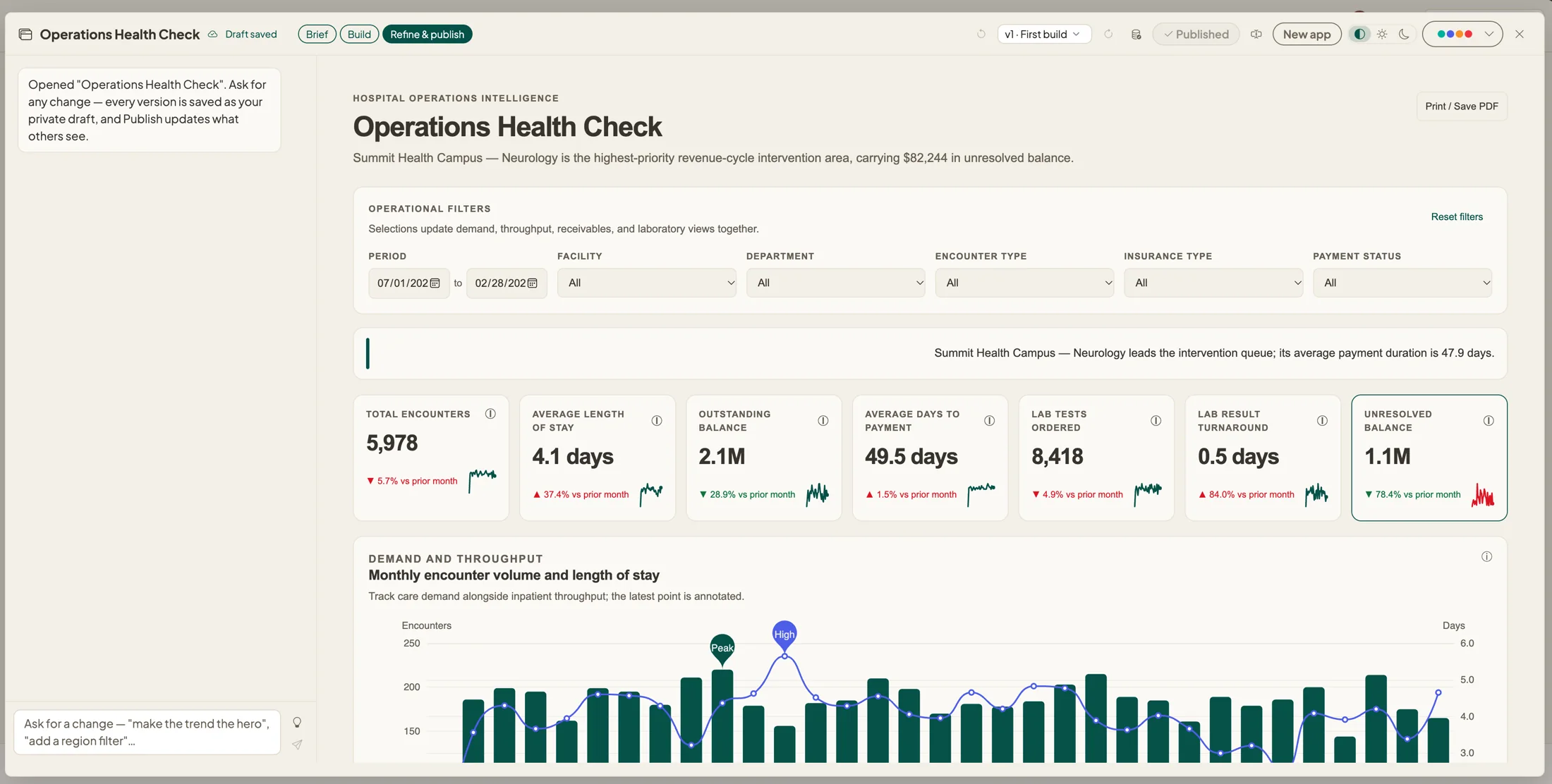
Any answer becomes a chart; charts compose into live dashboards your team can explore; and the dashboard becomes the PDF, spreadsheet or written summary your board actually reads. Put it on a schedule and it ships to email, Slack or Teams, after the data lands rather than before.

Runs on the same scheduler as your pipelines · Built from the same modeled views the analyst queries · Every figure keeps its SQL

Underneath

One platform underneath all three.

Ask, Watch and Deliver are three ways into the same install. Underneath: 75+ connectors, the pipelines that keep them fresh, a lakehouse that lands raw → cleaned → modeled (bronze, silver and gold, if you already speak medallion) in Apache Iceberg tables in your own storage account, a semantic model for every source, and Trino and Spark reading all of it. We assemble it. You don't.

Five stacked layers. On top, lit: the outcome — the analyst, agents and dashboards. Beneath it, in descending order: automations, the semantic layer, an open Apache Iceberg lakehouse on Trino and Spark, and 75+ connectors. Arrows point up from the stack to the outcome.

The full technical deep-dive, every module opened up →

Pricing

Priced by the minute, not by the seat.

No capacity units. No credits to forecast. You pay for three things, and every rate is on one page.

Compute
By the node-minute, only while a cluster is running. A small cluster is $2.00 per node-hour. Clusters start on demand and stop themselves.
Storage
Iceberg and Parquet in your own Azure account, billed by Azure at their rates, not ours.
AI tokens
At published per-model rates, or zero if you bring your own key.

No seat licenses. The analyst, the dashboards and the delivery ride the same compute meter as your pipelines.

See every rate →

Run it your way

Same platform. Two ways to run it.

Databasin Cloud · hosted

The fastest start.

Fully hosted and fully managed, HIPAA-ready from day one. Sign up, connect a source, and you are querying the same afternoon.

  • Nothing to deploy, nothing to patch
  • Per-minute pricing with every rate published
  • $50 in credit, no card

Your Azure tenant · self-install

Your tenant. Your posture.

Install from the Azure Marketplace and the whole platform runs inside your own walls. Your network, your keys, your policies, no data egress.

  • Data never leaves your tenant
  • Unlimited seats for the whole organization
  • Your compute and your LLM, billed by Azure with no markup
Talk to us about self-install →

Already committed to Databricks, Snowflake or Fabric? BYO mode layers Databasin on top of the platform you already have.

Warehouses store.
Databasin answers.

Just your email. We build your workspace and send your sign-in link.

$50 credit · No card · Sign in with Google or Microsoft

Bigger footprint or a security review? Talk to us.