Databasin vs Informatica
Choose Databasin when you want a team to move the data work and deliver the reporting or workflow that depends on it. Choose Informatica for a program drawing on its integration, quality, catalog and master-data capabilities. The starting point is what the current jobs do for the business and what their replacements must preserve.
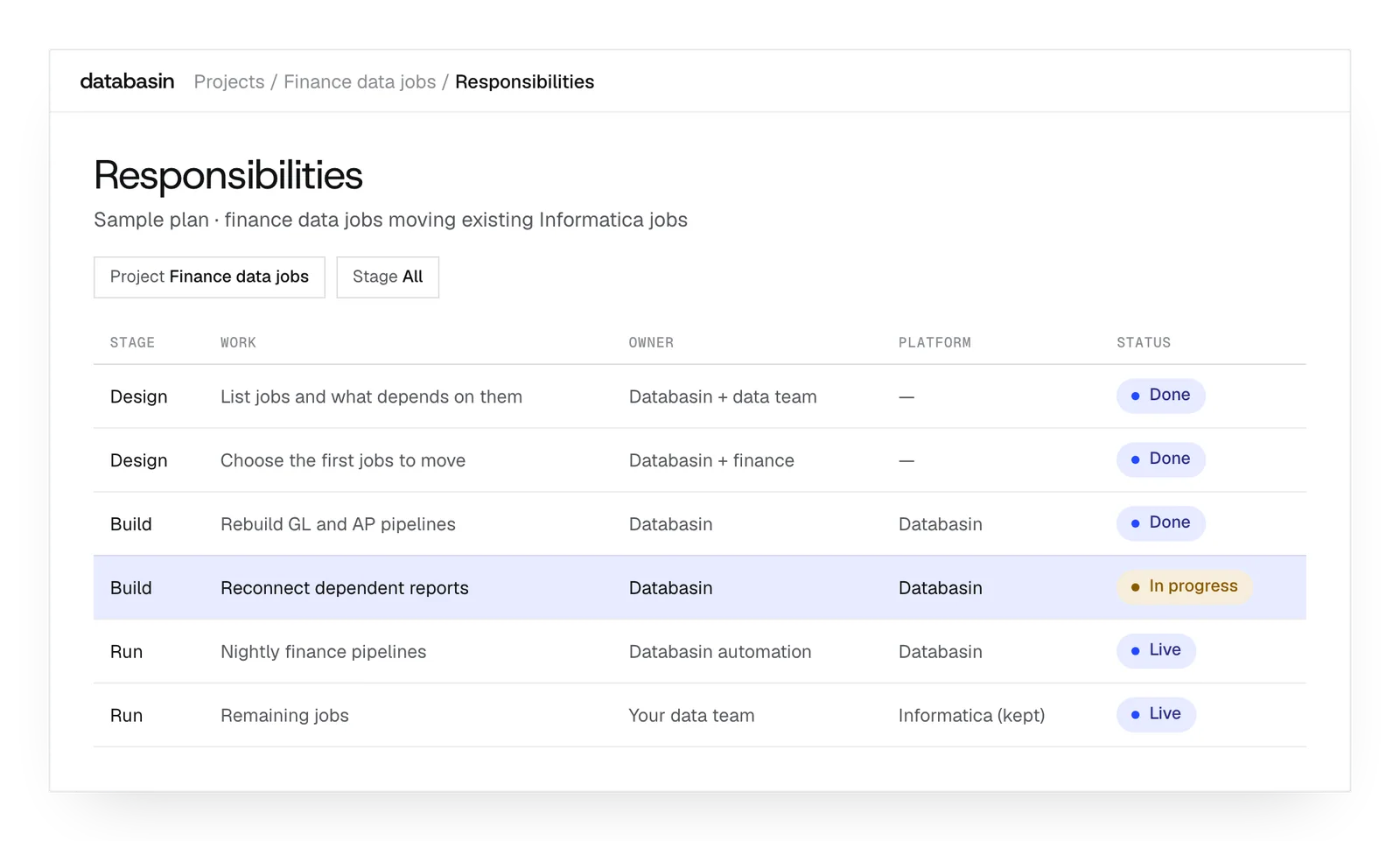
 databasinvs

Choose by migration scope
Choose Databasin if…
- You want the team rebuilding the integrations to deliver the application too.
- The project needs source work, shared definitions and user adoption.
- You want the delivery team to provide continuing operating support.
Choose Informatica if…
- Your program spans integration, data quality, governance and master data.
- Existing Informatica skills and assets support the intended migration.
- Your organization has selected an enterprise data management delivery approach.
What work does each cover?
| Criterion | Databasin | Informatica |
|---|---|---|
| Main scope | Delivered analytical or workflow improvement | Broad enterprise data management capabilities |
| Source movement | Pipelines with table-specific ingestion modes | Cloud integration and source connection services |
| Transformations | SQL, dbt and notebooks after ingestion | Integration mappings and transformation capabilities |
| Data management | Governed views for the implemented use case | Quality, catalog, governance and master-data services |
| Business output | Data Apps, chat and automated workflows | Data supplied to selected downstream applications |
| Delivery | Platform team implements and supports | Internal, vendor or partner service arrangement |
Migration design
What should the migration preserve?
Databasin
We follow the current data jobs through to the work people use them for. That shows us which calculations, historical records and delivery requirements the replacement must preserve. Those dependencies become part of the design before we start rebuilding the application.
- Trace source and calculation dependencies
- Establish historical reporting requirements early
- Define the output users must receive
Informatica
An Informatica migration can sit within a broader data management program. The platform includes integration, quality, governance and master-data capabilities. The organization selects the services and implementation arrangement needed for that scope, building on its existing integration knowledge.
- Assess the wider data management scope
- Select services for the intended architecture
- Build on established integration knowledge
Preparation
How is data prepared and governed?
Databasin
We move the source records through pipelines, then prepare them with SQL, dbt or notebooks. Keeping the heavier calculations after ingestion lets us work with the landed records. Our team builds the business views and access arrangements that the application needs.
- Choose ingestion behavior for each table
- Transform records after source synchronization
- Apply definitions to governed business views
Informatica
Programs can use Informatica cloud integration together with dedicated quality, catalog and governance capabilities. Those services address several disciplines across a data estate. Their selection depends on which systems and management requirements the program covers.
- Connect systems through integration services
- Apply selected data quality capabilities
- Extend catalog and governance practices
Business delivery
Who delivers the downstream improvement?
Databasin
We build the report or workflow at the end of the data process and help people start using it. Delivery includes communication, training and measures of success. The same team can then operate the work or provide the agreed continuing support.
- Build the intended business application
- Include rollout and training for users
- Agree operation or continuing support
Informatica
Informatica and its delivery partners offer implementation services. The chosen scope establishes how that work reaches the dependent business applications. Report changes, adoption and ownership beyond the data jobs all belong in the delivery arrangement.
- Select the appropriate implementation services
- Coordinate changes to dependent applications
- Establish ownership beyond the data jobs
Matching the scope of the program
Databasin
Deliver a specific improvement through migration and implementation
When a reporting or workflow problem defines the migration, Databasin can deliver its data work and application together. We trace the use case through its dependencies, rebuild what it needs and introduce the result to users. Useful platforms can remain part of the process.
- A reporting or workflow problem defines the project
- Integration and application delivery need coordinated implementation
- The business wants help operating the completed work
Informatica
Develop enterprise data management across a broader estate
Informatica fits a program that needs integration, quality, catalog and master-data capabilities across several applications. Its services provide components for that wider work. The organization selects the implementation arrangement around its architecture, existing expertise and the scope of the program.
- The program spans several data management disciplines
- Multiple applications depend on shared management services
- Existing architecture and expertise support that scope
Databasin · How we work · 2026
Informatica · Data management platform · 2026
Informatica · Cloud integration · 2026
What happens next
We would like to hear where your team wants to make progress with data and AI. We can discuss a project you have in mind or explore where Databasin could help with the work.
What happens next
Book a demo
Book a conversation about your organization and the work you want to improve. Questions about where to start are welcome.
Explore the opportunity
We show a working example that answers your business questions, then discuss what it would take to deliver it for your team.
Get the first result
After agreeing the first use case, we implement it with your team. We train the people using it and measure how it performs.
FAQ
Can Databasin automatically convert PowerCenter mappings?
A Databasin migration rebuilds the required behavior. Our team examines mappings, custom logic and downstream dependencies, then implements and tests their equivalents. The scope follows what the jobs do and the business outputs they support.
Where do complex joins run in Databasin?
SQL, dbt, notebooks and other automation tasks handle heavier transformations after the records land. Pipelines perform source synchronization, with light source SQL or filtering where needed. Joins and summaries can then use the landed records in the later calculation stages.
Must every table use the same ingestion mode?
No. Snapshot, Delta, Historical, CDC and Stored Procedure are available as table-specific modes. We select the mode around the changes a source exposes and the history the report needs. Tables with different update behavior can therefore be handled differently.
How are deleted records and late corrections handled?
We examine how the source exposes deletions and corrections, then compare that with the behavior of the existing jobs. The rebuild and its tests cover those cases. This checks the underlying history as well as whether the final totals agree.
How is recovery tested before a new workflow takes over?
Tests cover normal processing and recovery from an interrupted run. We check whether restarting duplicates records and whether later calculations wait for their inputs. The operating arrangement then names who responds when a recurring workflow requires attention.
Can the same approach apply to DataStage jobs?
Yes. We can examine DataStage sources, transformations and schedules as part of the migration. Our team rebuilds the required behavior and compares the replacement with the existing job outputs. Each workflow needs that assessment to establish what must carry forward.
Can the destination remain Snowflake, Databricks or Fabric?
Yes. We can keep the existing destination and improve the source path or the business application around it. Design establishes where processing will run and how the application reaches the records, preserving useful Snowflake, Databricks or Fabric work.
Should a migration start with the entire data estate?
We can start with one business use case and follow the jobs it depends on. Our team rebuilds that work and checks the result with its users. A working first delivery then gives the organization a basis for deciding which jobs and applications to address next.
Discuss your data migration
Talk with us about the integration work you want to change and the business results that depend on it. We can explore how Databasin would handle the implementation, preserve useful systems and support the completed workflow.