Databasin vs Microsoft Fabric
Choose Databasin when you want a team to deliver a business improvement, including the data, application and rollout. Choose Microsoft Fabric when your team or partner will build on Microsoft's integrated analytics services. An existing Fabric investment can stay: Databasin can work alongside it and help deliver the business capability the platform was intended to support.
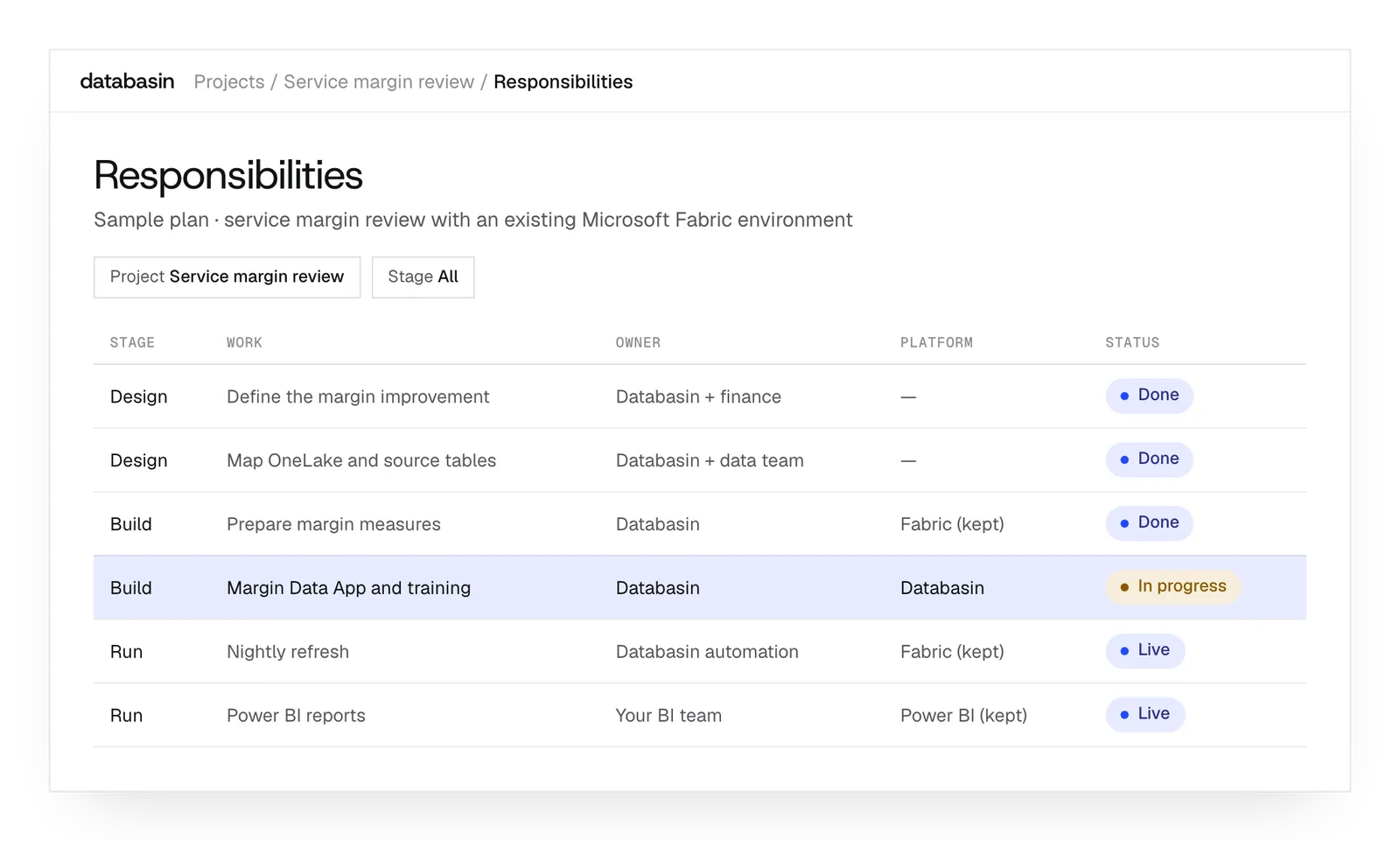
 databasinvs

Choose by delivery responsibility
Choose Databasin if…
- You want the builders of Databasin to deliver the business use case.
- The project needs source knowledge, process work and user adoption.
- You want help operating the result after it goes live.
Choose Microsoft Fabric if…
- Your team wants Microsoft's integrated engineering, analytics and reporting services.
- Existing Power BI models and reports support the planned application.
- Your internal team or partner can lead delivery and adoption.
What does each option include?
| Criterion | Databasin | Microsoft Fabric |
|---|---|---|
| Starting point | Business improvement delivered with its platform | Integrated Microsoft data and analytics services |
| Source work | Team implements connections and business views | Data Factory supports ingestion and transformation |
| Business access | Data Apps, chat or existing BI | Power BI and integrated analytical experiences |
| Adoption | Communication, rollout and training included | Planned by the implementation team |
| Ongoing work | Managed operation or agreed support | Managed platform with assigned application owners |
| Existing investment | Fabric can remain in the architecture | Extend workloads already using OneLake |
Design
Who designs the business improvement?
Databasin
We establish what the business wants to improve and how it will judge the result. Then we trace the current process with the people responsible for it. That work determines the data and application our team will build.
- Establish the problem and expected return
- Map the current business process
- Define the result and its measures
Microsoft Fabric
Your team or partner selects the Fabric workloads needed for the application. Engineering, warehousing, reporting and other services share OneLake as their data foundation. The builders design how those services will produce the required business result.
- Select workloads for the intended application
- Reuse the shared OneLake data foundation
- Define the implementation with your builders
Build
Who connects the data to daily work?
Databasin
We connect the sources, prepare shared measures and build the application. Our team also helps introduce it to the people whose work will change. Communication, rollout and training are included, so delivery reaches beyond the technical implementation.
- Connect sources and implement shared measures
- Build reporting or automated workflows
- Introduce the application to its users
Microsoft Fabric
Builders use Data Factory for ingestion, transformation and orchestration, alongside Fabric's other workloads. They can prepare records and develop reports in Power BI. The delivery team also organizes testing and the introduction of that work to users.
- Prepare data through pipelines and dataflows
- Coordinate dependent tasks within data workflows
- Develop reports with Power BI
Run
Who operates the completed application?
Databasin
Our team can operate the application after launch, support it each month or stay available on call. We agree which responsibilities that includes. The business then knows who will help when a model needs to change or a reporting process needs attention.
- Agree the ongoing operating responsibilities
- Support the implemented business application
- Continue improvements beyond the initial delivery
Microsoft Fabric
Microsoft manages the Fabric platform. The application owners handle changes to models, reports and the business process around them. This suits an organization whose internal team or partner will continue developing its analytical work in the Microsoft environment.
- Use managed analytics platform services
- Retain owners for applications and models
- Extend existing Microsoft operating practices
Keeping your Microsoft investment
Databasin
Add delivery help around an existing Fabric environment
Databasin can add delivery help while useful Fabric and Power BI work stays in place. We identify the source, model or application work still needed, then build it around the existing environment. The engagement defines how the completed result will be operated.
- Source or model work is delaying business use
- Existing reports remain useful to their recipients
- Implementation needs help beyond the available team
Microsoft Fabric
Extend the environment with your current delivery team
Fabric fits when the current delivery team can complete the application within the Microsoft environment. It can use the models, access arrangements and reporting skills already in place. That is a sound basis for another use case when the required sources and workloads fit that architecture.
- Current Microsoft architecture supports the intended application
- Power BI already serves the business effectively
- The delivery team can introduce and support changes
Databasin · How we work · 2026
Microsoft · What is Microsoft Fabric? · 2026
Microsoft · What is Data Factory in Microsoft Fabric? · 2026
What happens next
We would like to hear where your team wants to make progress with data and AI. We can discuss a project you have in mind or explore where Databasin could help with the work.
What happens next
Book a demo
Book a conversation about your organization and the work you want to improve. Questions about where to start are welcome.
Explore the opportunity
We show a working example that answers your business questions, then discuss what it would take to deliver it for your team.
Get the first result
After agreeing the first use case, we implement it with your team. We train the people using it and measure how it performs.
FAQ
Does a stalled Fabric rollout mean we need another platform?
A stalled rollout can reflect unfinished source access, definitions, application work or adoption. We examine those dependencies during design. Where Fabric still serves the intended result, our team can retain it and complete the work preventing people from using it.
How would Workday history reach a Fabric-based reporting process?
The Workday connection handles object relationships and effective-dated history. We design how those prepared records reach the retained platform and its reports. For a past-period measure, the model needs to carry the historical values and dates through the calculation.
Can Data Apps reproduce every Power BI report element?
Power BI report conversion in Data Apps is in beta. We examine the report and its calculations to establish what transfers and what needs further work. Before replacing the current report, our team checks both the behavior and the presentation of the converted result.
What evidence accompanies a Databasin One answer?
SQL and source evidence accompany the answer. Users can examine the definitions and calculation behind a result. When they ask a follow-up that changes the period or grouping, the new query shows how that change was applied.
Does Databasin require a separate public-cloud environment?
No. We can use hosted deployment, Private Azure or an arrangement alongside an existing platform. During design, we establish where the work runs and how it reaches its sources. The connection must fit the access arrangements of the chosen environment.
Is open storage a reason to leave Fabric?
The stored tables are only part of the application. Models, workflows, permissions and report behavior also determine what it would take to move. We examine those dependencies when deciding what to retain, so the platform choice accounts for the complete working application.
How are source refreshes and reporting runs coordinated?
Each calculation follows the source updates it requires. Databasin runs automation stages in sequence, with parallel tasks available within a stage. Fabric has Data Factory orchestration as well. We assign each part of the sequence to the system chosen in the architecture.
What does the first 90 days cover?
Our offer is a first use case live in 90 days. We agree the outcome and scope during Design. Build covers the technical work and the communication, rollout and training that people need to start using the result.
Discuss your next business improvement
Talk with us about the business work you want to improve and the Microsoft systems already in place. We can explore how Databasin would contribute, including what to retain and how the completed work would be supported.