Most Epic questions wait in the report queue because only a few Clarity specialists know the tables. Databasin brings Clarity and Caboodle data into a governed lakehouse in your own Azure tenant, so researchers, finance teams and operations leaders can ask in plain English and see the SQL behind each answer. We built it at WashU Medicine, where it runs in production today.




Results from customer work

- 20+ systems unifiedDatabasin brought WashU Medicine's financial data together.
- Infrastructure costs at 1/3 of the traditional approachWashU Medicine's result from changing its data infrastructure.
18%
Higher grant proposal success
Measured at a research institution working with Databasin.
“What used to take weeks or sometimes even months now happens in minutes.”
Epic analytics for healthcare teams
Epic analytics with Databasin gives people a way to explore prepared clinical and business data without learning Clarity's table structure or filing a ticket with a Clarity specialist. Our team connects Clarity, and Caboodle where your institution has it, and adapts the records to your institution's local build. We establish the measures that the application will use, including the definitions and reporting periods that make a result meaningful to its readers.
That preparation can support a research cohort, an operational review or a finance application. People ask follow-up questions in Databasin One and keep useful views in Data Apps. The underlying definitions can also support existing BI tools. Databasin was co-created at Washington University School of Medicine and runs in production there today. We bring that experience to the connections, local mappings and applications your teams need.
Work across healthcare teams
Research questions
We create views of approved cohort records from Clarity. Researchers can use them to ask further questions in plain English, open the SQL and examine how an answer selected the records.
Operational reviews
We prepare length of stay and other measures with the relevant unit and period definitions. Operations teams can use those calculations when comparing their results.
Finance analysis
We connect charge, payment and denial records for financial analysis. A finance user can inspect a change in a measure and the records that explain it.
Departmental applications
We build Data Apps for the views a department uses regularly. Colleagues open the shared link and investigate through filters using their permitted data.
Implementation for your healthcare teams
Design
Define the result
We work with the clinical, research or business leaders to identify the decision the application should support. That gives the data work a defined purpose.
Connect
Prepare the records
We arrange the reporting route, map local fields and prepare the measures. We also help explain that route in the institution's security review.
Build
Implement the application
We build the application and review its results against source records. Users receive training on the measures and how to investigate them as part of rollout.
Run
Support continued use
We agree the operating arrangement after launch. Databasin can run the application, provide monthly support hours or remain available on call as the work develops.
Example: reviewing a research cohort
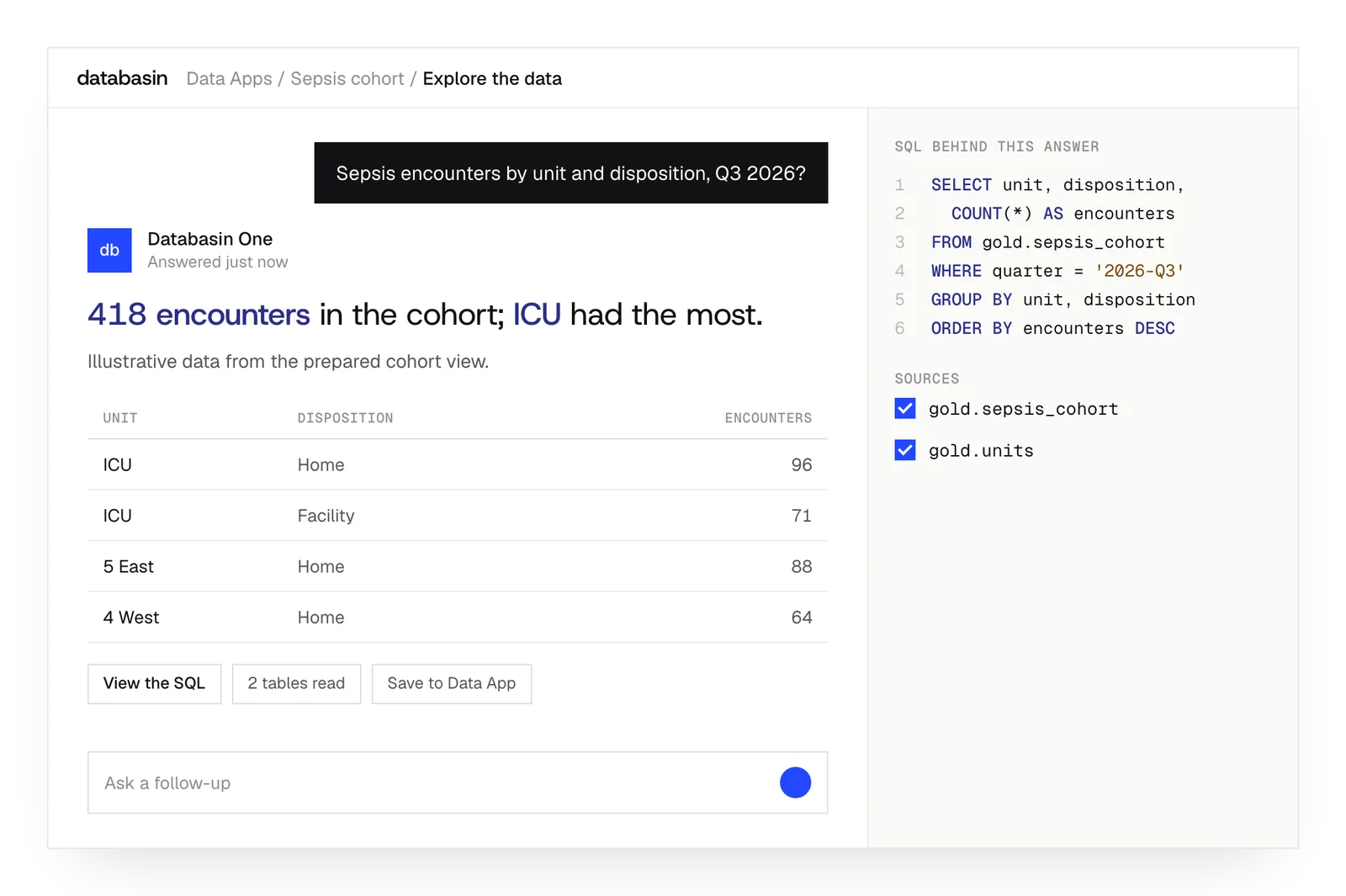
A researcher can review sepsis encounters by unit and disposition using a prepared cohort view. Databasin One returns an answer with the query attached, so the researcher can examine how the records were selected.
A Data App can retain the useful view for subsequent reviews. The research team interprets the findings and decides how to use them.
Security for business data
Databasin gives your team controls for who can use business data and records of how they use it.
Access
Your organization manages the identities people use to sign in. Data permissions apply to their work, and investigation agents have read-only access to production sources.
Regulated data
For work involving PHI or HR data, our team helps your security reviewers examine the requirements. Databasin is HIPAA-ready, with a BAA available.
Where data sits
You can use our hosted service, run Databasin in your own Azure tenant so PHI stays in your environment, or use it alongside Databricks, Snowflake or Microsoft Fabric.
Audit
An answer comes with its SQL for review. Your team can also examine query logs and lineage to understand the data behind it.
What happens next
We would like to hear where your team wants to make progress with data and AI. We can discuss a project you have in mind or explore where Databasin could help with the work.
What happens next
Book a demo
Book a conversation about your organization and the work you want to improve. Questions about where to start are welcome.
Explore the opportunity
We show a working example that answers your business questions, then discuss what it would take to deliver it for your team.
Get the first result
After agreeing the first use case, we implement it with your team. We train the people using it and measure how it performs.
FAQ
Can an analysis include our locally configured flowsheets?
We examine the local fields needed for the question and map them during preparation. Epic implementations differ, so the application must use the records and meanings from your institution. The technical architecture explains this work in more detail.
What happens when we change a quality measure?
We update the shared definition and the preparation that uses it. The effect on existing applications and reporting periods is part of that change. Preserved source records let analysts revisit the calculation when the definition needs to change.
Can a coordinator see whether a refresh completed?
Pipeline and automation run records show status and task details. A coordinator or analyst with access can inspect that record before using a report. This helps distinguish a completed refresh from a preparation run that needs attention.
Will every department see the same patient records?
Access follows the permissions established for the deployment and its users. Shared calculations do not require unrestricted access to every record. We help design the views and access needed for each application, including work involving protected health information.
Can we preserve a familiar Power BI report layout?
The Data Apps importer can rebuild a Power BI report on connected tables and identify elements that did not translate. We address those elements during implementation, so the familiar report can become a live application people continue to use.
Can an approved spreadsheet feed join the Epic records?
Yes. File ingestion can contribute data to the prepared views. We establish the relationship between those records and Epic data, then apply the definitions and checks needed for the question the combined view will answer.
Can another department use the first application's preparation?
It can reuse the source connections and definitions that fit its work. We examine the additional measures and access it needs, then extend the prepared views. That lets later applications build on useful work already completed.
Is this a replacement for Epic's operational clinical system?
This page describes analysis of Epic reporting data for research, finance and operations. The application reflects its source refresh and prepared measures. Clinical operations continue in Epic; the analytics help authorized people investigate the reporting records.
Discuss your Epic questions
We can talk through the questions your clinical, finance or research teams need to answer. A demo can explore how Databasin would make that information useful and where hands-on help would support the work.