Ask your research data questions in plain language
At the AMIA 2026 Annual Symposium, we take OMOP data from raw tables to a shared dashboard by typing requests into Databasin One. Try it yourself on the same synthetic data.
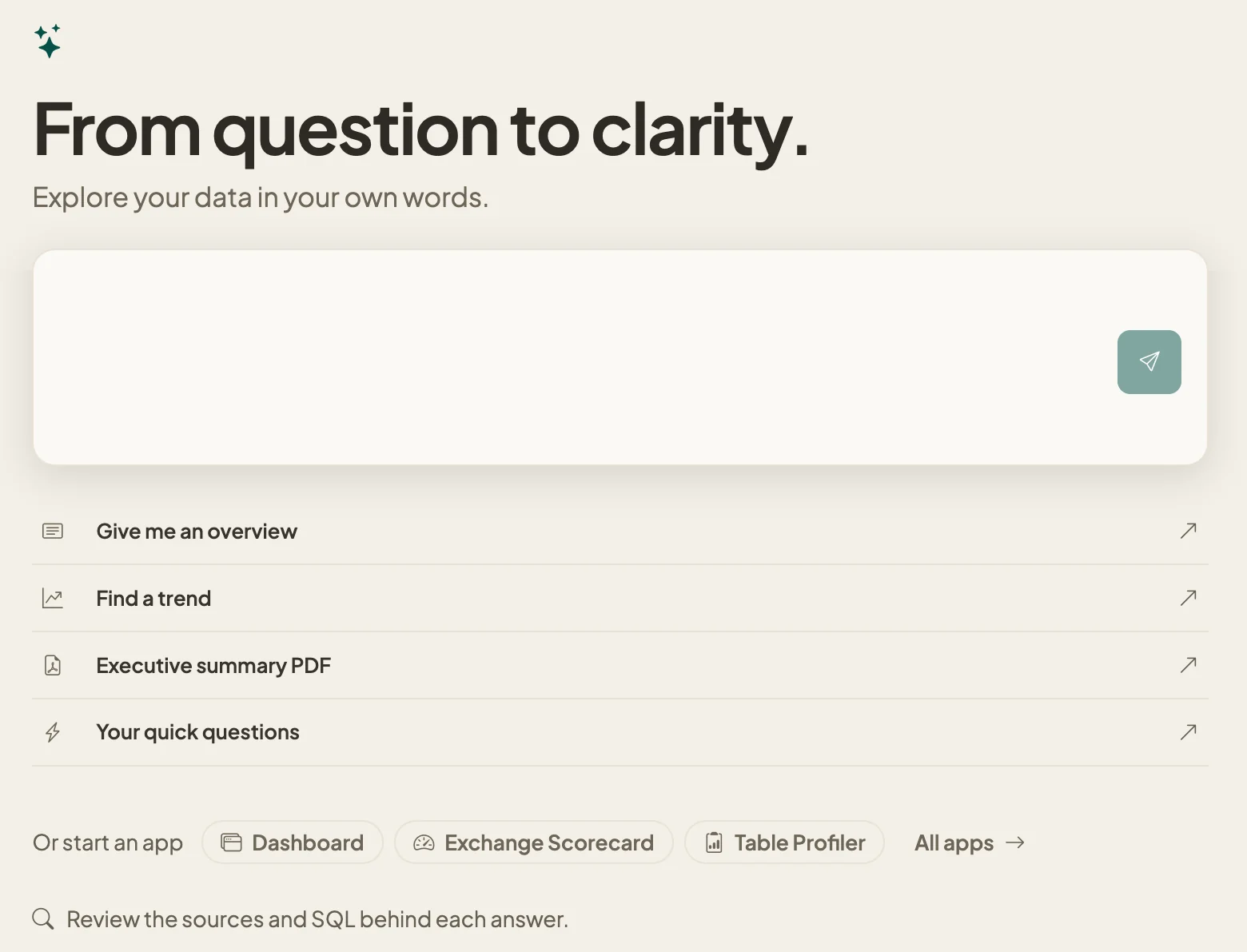
One example from our session
We use GiBleed, a synthetic OMOP dataset from OHDSI, to compare two NSAIDs. Asked for the rate of GI bleeds within 30 days of the first dose, Databasin One gives a simple answer: 6.1% for celecoxib and 5.4% for diclofenac.
Then we ask a follow-up:
“Split that rate by drug and by whether the patient had a peptic ulcer before starting.”
Now there are two patterns. Without a prior ulcer, celecoxib’s rate is lower. With one, it’s higher, though the diclofenac figure rests on only 8 bleeds.
| GI bleed within 30 days | Celecoxib | Diclofenac |
|---|---|---|
| No prior peptic ulcer | 3.2% (38 of 1,175) | 5.3% (38 of 717) |
| Prior peptic ulcer | 11.2% (75 of 669) | 6.0% (8 of 133) |
The data is synthetic and these rates are unadjusted, so this shows the method and isn’t a clinical finding.
Learn more about what your team could do
More than 75 connectors, including Epic Clarity, Workday, FHIR, Box and NIH RePORTER, feed one lakehouse. Databasin One can set up a connection and its sync by conversation.
A Data Exchange holds your team’s definitions, so the next person who asks gets the same cohort and the same calculation.
Researchers can ask without knowing the table names, and each answer comes with the query behind it.
An agent can refresh the numbers on a schedule and post the summary to Teams, Slack or email.
Describe the dashboard you need, then share it with a link. Each viewer sees only what their access allows.
One set of permissions covers people and the assistant, and every query is logged. We run it for you, or we can install it in your own Azure tenant.
Built with WashU Medicine
WashU Medicine co-developed Databasin because commercial tools couldn’t handle the complexity of research at an academic medical center. It brings clinical, research and administrative data together across more than 70 groups. It runs in production at WashU Medicine and is deployed at additional academic medical centers.
Jake Gower and Chris Lundeberg present this work at AMIA as “Built by Researchers, for Research,” a Systems Demonstration in Clinical Research Informatics.
Try it with the same data
Sign up, download GiBleed, unzip it and add the CSV files. Then ask your own questions. If you want to use real patient data, book a call first and we’ll start with a technical architecture review.